
Why Your Marketing KPIs Don’t Belong to Marketing
In a previous article, I explained why marketing isn’t a “normal” hire.
It doesn’t sit neatly within one function. It’s not contained. It touches product, sales, operations, finance and leadership. It requires clarity before it can create momentum.
However, there’s a deeper structural reason why first-time marketing hires often struggle.
It’s this: Marketing outputs are contingent on inputs beyond marketing’s control.
And unless that reality is understood before hiring, even strong marketers can underperform.
Let me explain.
What Job Descriptions Reveal
Consider a fairly typical Marketing Manager role.
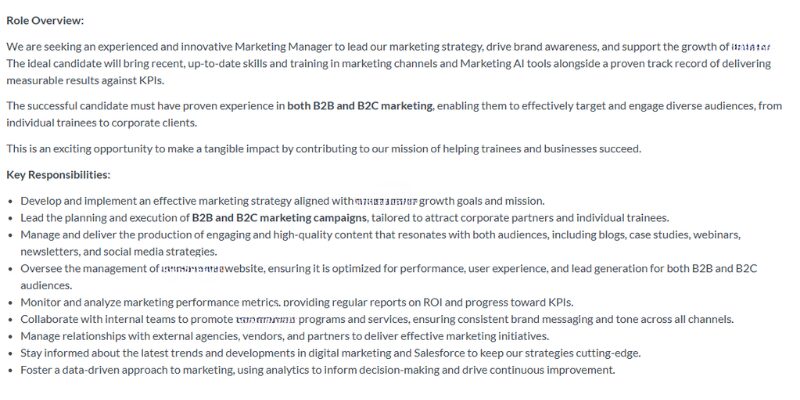
The brief includes:
- Develop and implement strategy aligned to growth goals
- Drive brand awareness
- Deliver B2B and B2C campaigns
- Increase qualified leads
- Improve website traffic and conversions
- Improve social engagement
- Improve email performance
- Strengthen SEO rankings
- Report on ROI
- Manage agencies
- Stay ahead of AI and marketing tools
All reasonable, all familiar, but look more closely at the KPIs, it goes on to detail:
- Growth in qualified leads
- Increased website traffic and conversions
- Improved social engagement
- Stronger email performance
- SEO ranking improvements
- Positive trainee and business feedback
On the surface, these appear to be marketing outcomes.
In practice, they are organisational outcomes.
Let’s Break Down What These KPIs Actually Depend On
1. Growth in Qualified Leads
This sounds like a pure marketing metric, but it rarely is, it depends on:
- Clear positioning
- A compelling offer
- Defined pricing strategy
- A shared definition of “qualified” between marketing and sales
- A functioning follow-up process
- Realistic revenue targets
Marketing can increase visibility and generate interest, but if sales don’t respond quickly, if qualification criteria are unclear, or if the offer itself lacks clarity, lead growth will stall regardless of campaign performance.
When “qualified leads” are not structurally defined, marketing ends up judged against a moving target.
2. Website Traffic and Conversions
Traffic is partly within marketing’s influence. Conversions aren’t; they’re dependent on:
- The clarity of the value proposition
- The competitiveness of the programme
- The simplicity of the sign-up journey
- Operational responsiveness
- Customer experience after first contact
Marketing can optimise messaging, but it cannot repair a slow admissions process, unclear programme outcomes, or friction in onboarding.
If operational systems are inconsistent, the website cannot compensate.
3. Social Media Engagement and Follower Growth
Engagement reflects:
- Brand clarity
- Thought leadership
- Authentic voice
- Internal contribution
If leadership is unwilling to be visible, if there’s no clear perspective, or if the brand itself lacks differentiation, engagement will plateau.
This is not a creativity issue. It’s a strategic clarity issue.
4. Email Open and Click-Through Rates
These metrics are heavily influenced by:
- Database quality
- Audience segmentation
- Sales feedback loops
- Programme cycles
- Offer relevance
If lists are outdated or poorly segmented, no subject line will rescue performance. If there’s no clarity on who the ideal trainee or corporate partner is, email metrics will fluctuate unpredictably.
5. SEO Rankings
SEO improvements require:
- Technical website foundations
- Developer input
- Consistent content investment
- Long-term strategic focus
Without technical resources and patience, SEO KPIs become unrealistic expectations placed on a single hire.
6. Positive Trainee and Business Feedback
This is perhaps the most revealing KPI. Feedback is influenced by:
- Programme quality
- Customer support
- Delivery consistency
- Expectation setting
- Post-sale experience
Marketing can attract the right audience. It cannot improve the product experience once a trainee begins. When feedback declines, the root cause is often delivery, yet the marketer may feel the pressure first.
The Structural Reality
Unlike a salesperson, whose output is closely tied to individual performance, or a developer, whose work produces visible features, marketing is a multiplier function.
Multipliers amplify what already exists.
If positioning is strong, sales processes are clear, and delivery is consistent, marketing accelerates growth.
If those foundations are weak, marketing amplifies confusion.
That’s why it feels volatile. Not because marketing is unpredictable, but because it reveals structural gaps quickly.
Why This Matters Before You Hire
When a job description lists ambitious KPIs without clearly defined inputs, the risk isn’t that the marketer lacks skill, it’s that the organisation hasn’t yet defined:
- What “qualified” truly means
- What the customer journey looks like end-to-end
- How sales and marketing collaborate
- What budget supports the growth ambition
- What realistic timelines for impact are
Without that clarity, performance reviews become emotional. The conversation shifts from structure to personality, from systems to individual capability, and that’s where misalignment begins.
Marketing Is Not a Self-Contained Function
It’s a connector function. It translates product into promise, strategy into visibility, insight into demand, but it cannot operate independently of:
- Leadership clarity
- Sales alignment
- Operational capacity
- Product confidence
When those inputs are unstable, KPIs fluctuate. When they’re strong, marketing compounds.
The Question Founders Should Ask
Before asking, “Can this Marketing Manager deliver these KPIs?”
Ask: Have we defined and stabilised the inputs that those KPIs depend on?
If the answer is uncertain, the hire becomes a structural experiment. If the answer is clear, the hire becomes a growth driver.
Marketing doesn’t fail because it’s weak. It fails when the organisation expects it to compensate for unresolved foundations.
That’s why it’s not like any other hire.
And that’s why readiness matters more than recruitment.